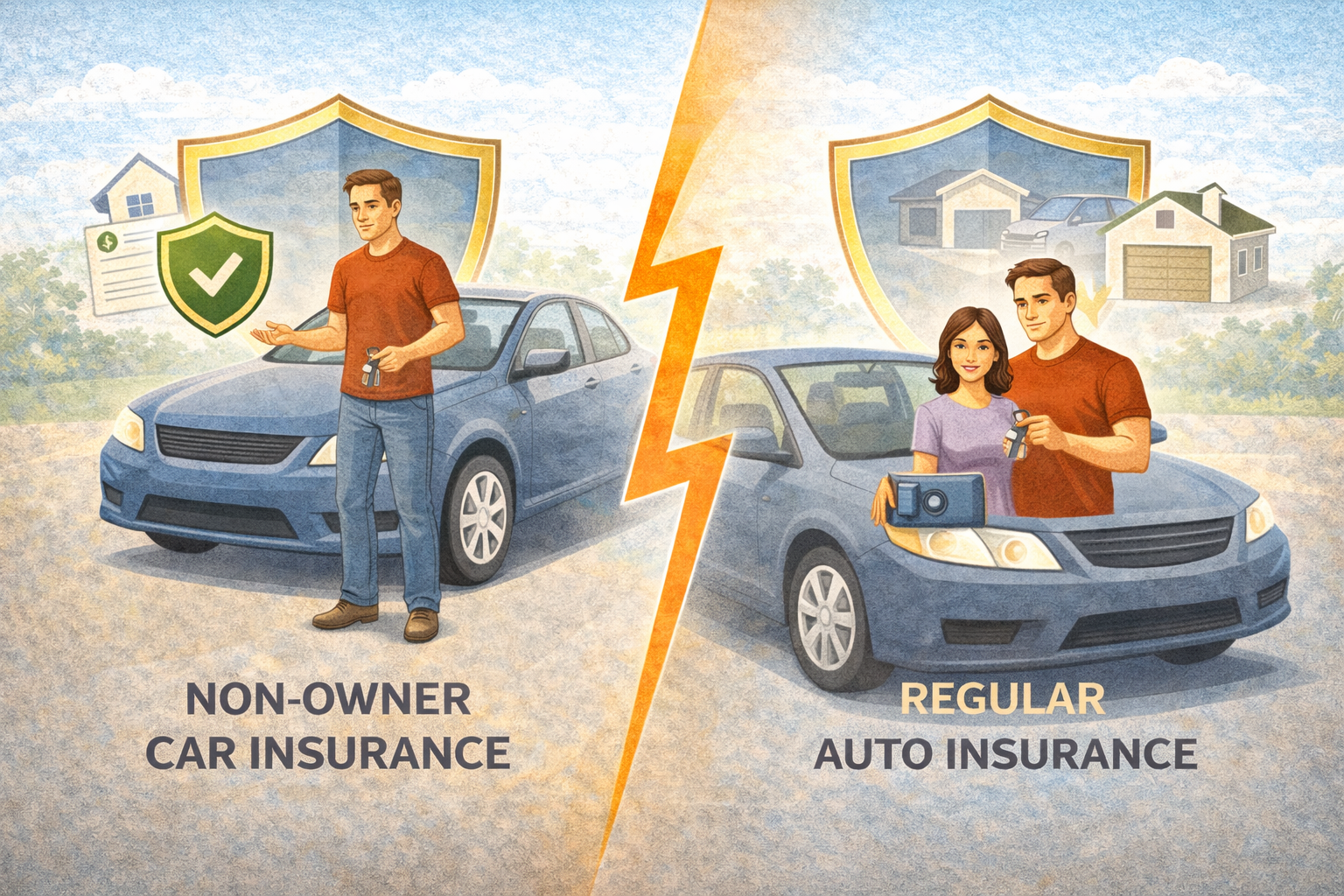
If you do not own a car, buying “regular” auto insurance is often impossible — and if you do own one, a non-owner policy will not protect it. That single distinction explains most of the confusion around non-owner car insurance vs regular auto insurance, and it is the first thing an insurer checks when you apply.
This guide compares the two policy types across every dimension that actually affects your premium, your claims, and your legal exposure: what each one covers, who qualifies, how a claim is paid when you are driving someone else’s car, what each costs in 2026, and the specific situations where choosing the wrong one leaves you uninsured at the worst possible moment.
Quick answer: the one-line difference
A non-owner car insurance policy covers your liability while you drive vehicles you do not own. A regular auto insurance policy covers both your liability and the physical damage to a specific, insured vehicle. Non-owner policies require no vehicle; regular policies require one. Everything else — cost, limits, claims handling, state compliance — follows from that difference.
| Dimension | Non-Owner Car Insurance | Regular Auto Insurance |
|---|---|---|
| Vehicle required | No — by definition you do not own one | Yes — tied to a VIN |
| Bodily injury liability | Yes, core coverage | Yes, core coverage |
| Property damage liability | Yes, core coverage | Yes, core coverage |
| Collision (damage to the car you drive) | Never | Yes, if purchased |
| Comprehensive (theft, weather, vandalism) | Never | Yes, if purchased |
| Medical payments / PIP | State-dependent, often available | Yes, state-dependent |
| Uninsured / underinsured motorist | State-dependent, often available | Yes, usually recommended |
| Position when driving a borrowed car | Excess — pays after the owner’s policy | Primary for your own vehicle |
| Can satisfy state minimum requirements | Yes, in most states | Yes |
| Can file an SR-22 / FR-44 | Yes — one of its main uses | Yes |
| Typical annual cost (2026) | Roughly $200–$800 | Roughly $1,200–$2,500+ |
| Who it fits | Carless drivers who still borrow, rent, or need proof of coverage | Anyone who owns or regularly drives one vehicle |
1. Eligibility: who can actually buy each policy
Non-owner policy eligibility
Insurers underwrite non-owner policies on the assumption that you have no regular access to a vehicle. You generally qualify if you can truthfully answer no to all of these:
- Is a vehicle titled or registered in your name?
- Do you have exclusive, regular access to a car (including a company car or a spouse’s car you drive daily)?
- Is any vehicle principally garaged at your address?
If you answer yes to any of them, most carriers will decline the non-owner application and require a standard policy instead. Some will still issue one but exclude claims arising from the vehicle you have regular access to — which is worse than being declined, because you pay for coverage that will not respond when you need it.
Regular policy eligibility
A regular policy requires a specific vehicle: a VIN, a garaging address, and usually a lienholder or lease company if the car is financed. The named insured must have an insurable interest in that vehicle. You cannot buy a regular policy “just in case” for a car you do not own.
2. How a claim is actually paid when you drive a borrowed car
This is the most misunderstood part of the comparison, and the one that decides whether you have real protection.
When you borrow a friend’s car and cause an accident, the vehicle owner’s policy pays first. It is primary. Your non-owner policy only responds after the owner’s liability limits are exhausted — it sits in an excess position. That has three consequences worth understanding before you buy:
- Your non-owner policy does not replace the owner’s insurance. If the owner carries state-minimum limits, a serious injury claim can blow through those limits quickly and land on your excess policy. That is exactly the scenario non-owner coverage exists for.
- Damage to the borrowed car is never covered by your non-owner policy. Collision and comprehensive coverage follow the vehicle, not the driver. If you total a friend’s car, their own collision coverage (if they bought it) handles the vehicle; your policy handles the injury and property damage you caused to others.
- Rental cars work differently. A rental company’s coverage is primary, your personal auto or non-owner policy is usually secondary, and your credit card may add another layer. Stacking these correctly is worth a separate look — see our breakdown of how non-owner coverage interacts with rental cars.
3. Cost comparison: what you actually pay in 2026
Non-owner policies cost a fraction of regular policies because the insurer is not on the hook for a vehicle. There is no collision payout, no comprehensive payout, no total-loss exposure. What remains is pure liability risk, priced against your driving record and your state’s claim environment.
| Driver profile | Non-owner annual premium | Regular annual premium |
|---|---|---|
| Clean record, low-cost state (e.g. rural Midwest, Southeast) | $200–$400 | $1,100–$1,600 |
| Clean record, average-cost state | $300–$550 | $1,500–$2,000 |
| Clean record, high-cost state (MI, FL, NY, LA) | $500–$800 | $2,200–$3,500+ |
| One at-fault accident or ticket in the last 3 years | +20% to +45% | +30% to +60% |
| SR-22 filing required | $500–$1,200 | $1,800–$4,000+ |
Two pricing details that surprise people:
- The gap widens in expensive states. In Michigan or Florida, a regular policy can run four to six times the cost of a non-owner policy for the same driver, because the vehicle-related portion of the premium is where the money goes.
- A lapse costs more than the policy did. Going even one day without continuous coverage can raise your future premium by 15–30% for years. If you sell a car and will not buy another immediately, a non-owner policy is usually cheaper than the surcharge for a gap. Full pricing breakdowns live in our guide to non-owner car insurance cost in the United States.
4. When each policy is legally required
You need a regular policy when:
- A vehicle is registered or titled in your name — every state ties insurance to the registered owner.
- You finance or lease a car — the lender or lessor contractually requires collision and comprehensive coverage, usually with a maximum deductible. A non-owner policy cannot satisfy this.
- You drive the same vehicle daily, even if someone else owns it. Most policies define a “regular operator” who must be listed, and a non-owner policy will not respond for that vehicle.
- You need coverage for the vehicle itself — theft, hail, a collision you caused.
You can use a non-owner policy when:
- You have no vehicle but must show proof of financial responsibility to the DMV — to reinstate a suspended license, satisfy an SR-22 or FR-44 requirement, or clear a registration hold.
- You borrow or rent cars occasionally and want liability protection above what the owner’s policy provides.
- You want to keep continuous coverage on record between vehicles so your next policy is not surcharged for a lapse.
- Your job requires a valid driver’s license and proof of insurance, but you do not own a car.
If an SR-22 filing is what is driving your search, the rules are strict enough to deserve their own treatment — start with our guide to non-owner SR-22 insurance before you buy anything.
5. Coverage limits: where the real difference hides
Both policy types express limits in the same three-number format — for example, 25/50/25 means $25,000 bodily injury per person, $50,000 per accident, and $25,000 property damage. The difference is not the format; it is what sits underneath the limits.
- Non-owner: the liability limits are the entire policy. There is no vehicle to repair, so there is nothing else to insure. Many carriers cap non-owner limits lower than they would for a regular policy — some stop at 100/300, and a few stop at state minimums.
- Regular: liability limits sit on top of physical damage coverage. You can carry a low liability limit and a low deductible, or the reverse, and the premium moves accordingly.
Practical implication: if you have meaningful assets to protect, ask specifically what maximum liability limit the carrier will write on a non-owner policy. A state-minimum non-owner policy protects your license, not your savings.
6. Switching between the two
Switching is routine and does not require canceling and restarting coverage — which matters, because a gap is what triggers surcharges.
| Life event | What to do | Timing |
|---|---|---|
| Selling your car, not buying immediately | Convert the regular policy to a non-owner policy on the same account | Same day the sale completes — do not let the policy lapse |
| Buying a car while holding a non-owner policy | Add the vehicle to the existing policy or rewrite it as a standard policy | Before you drive it off the lot; coverage follows the VIN from the moment of purchase in most states |
| Between vehicles for a few weeks | Keep the non-owner policy running, then convert back | Continuous — never cancel first and shop later |
| Moving to a new state | Re-shop both; state minimums and non-owner availability differ | Within the state’s grace period after establishing residency |
One caveat: not every carrier writes both products, and some that do will treat a conversion as a new policy with a new rate. Get the conversion quote before you sell the car, not after.
7. Common misconceptions that cost people money
“Non-owner insurance is the cheap, inferior version.” It is not inferior — it is a different product with a narrower job. It is inferior only when someone buys it expecting it to cover a car they actually own or drive daily.
“Regular insurance is always better because it covers more.” It covers more only if there is a vehicle to cover. Buying a regular policy for a car you do not own is not possible, and paying for one you no longer drive is wasted premium.
“My non-owner policy covers me in any car, so the owner does not need insurance.” False, and in most states illegal. The owner must carry their own coverage; yours is excess.
“I can buy a non-owner policy and then drive my roommate’s car every day.” This is the most common way people void their own coverage. Regular access to a vehicle means you are not a non-owner risk, and a claim in that vehicle is likely to be denied.
More of these traps are collected in our breakdown of the confusion that costs drivers thousands and in one driver’s account of learning it the hard way.
8. A four-question decision test
Answer these in order. The first “yes” determines your answer.
- Is a vehicle registered in your name, or do you have regular access to one? Yes → regular policy. No → continue.
- Does a lender, lessor, or state require physical damage coverage on a specific vehicle? Yes → regular policy. No → continue.
- Do you need to show proof of financial responsibility to a DMV, court, or employer? Yes → non-owner policy.
- Do you borrow or rent cars often enough that liability exposure matters? Yes → non-owner policy. No → you may not need either, but check your state’s rules before going uninsured.
If you land on a non-owner policy but are unsure which one fits your situation — cheap coverage, SR-22 filing, or a standard liability policy — the comparison in non-owner insurance vs regular: which one walks through the edge cases, and this plain-language guide for drivers covers the same ground with less jargon.
Frequently asked questions
Can I have both a non-owner policy and a regular policy at the same time?
Yes, and some people legitimately do — for example, someone who owns a weekend car kept at a second home but regularly drives a company vehicle elsewhere. In that case the regular policy covers the owned vehicle and the non-owner policy provides excess liability for the vehicles you do not own. Expect the insurer to ask detailed questions about which vehicle you drive most often, because that determines which policy is primary.
Does a non-owner policy cover me if I am hit by an uninsured driver?
Only if you purchase uninsured/underinsured motorist coverage, and only in states where it is available on a non-owner policy. It is not automatic. In states that require UM/UIM, the carrier must offer it; in others you have to ask. Given that roughly one in seven U.S. drivers is uninsured, this is worth asking about explicitly.
Will a non-owner policy raise my rates if I have an accident?
It can, but the effect is smaller than on a regular policy because there is no vehicle damage component. A single at-fault claim on a non-owner policy typically increases the premium by 20–45% at renewal, and the surcharge usually stays for three years.
Is non-owner insurance accepted for an SR-22 filing?
Yes, in most states. The insurer files the SR-22 certificate with the DMV on your behalf, confirming that you carry the required liability limits. The requirement is about financial responsibility, not vehicle ownership, which is exactly what a non-owner policy provides. Florida and Virginia use a similar but stricter form called FR-44, which requires higher limits.
What happens if I buy a car while I have a non-owner policy?
You need a regular policy before you drive it. Most carriers will let you add the vehicle to the existing policy mid-term, which preserves your continuous-coverage discount. Do not assume the non-owner policy automatically extends — it does not, because it was written on the premise that you own no vehicle.
How much liability coverage should I carry on a non-owner policy?
At minimum, enough to cover your state’s requirements plus whatever a serious injury claim could realistically reach. A common benchmark is 100/300/100 — $100,000 per person, $300,000 per accident, $100,000 property damage — if the carrier will write it. State minimums exist to keep you legal, not to protect your assets.
Can I get a non-owner policy if I have a DUI or a suspended license?
Often yes, but the pool of carriers shrinks and the premium rises sharply. You will typically need an SR-22 filing, and some carriers require the license to be reinstated first. High-risk non-owner policies can run $1,000–$2,000 a year.
Does a non-owner policy cover a rental car’s damage?
No. It covers your liability to others, not damage to the rental vehicle. The rental company’s collision damage waiver or your credit card’s coverage handles the vehicle itself. What your non-owner policy adds is liability protection above the rental company’s limits.
The bottom line
The choice between non-owner car insurance and regular auto insurance is not a matter of preference — it is determined by whether a vehicle is yours. If one is, a regular policy is the only thing that works. If none is, a non-owner policy is the only way to hold liability coverage and stay compliant. The expensive mistakes happen in the gray zone: buying a non-owner policy while having regular access to a car, or letting coverage lapse during a transition between vehicles.
If your situation involves a filing requirement rather than a vehicle, the practical steps — paperwork, timelines, and what trips up most applicants — are covered in our guide to non-owner SR-22 insurance.
Related Guides
- How Much Does Non-Owner Car Insurance Really Cost? (My Personal Experience &…
- Non-Owner Car Insurance vs. Regular Auto Insurance: What I Learned the Hard Way
- How Much Is GEICO Non Owner Car Insurance Per Month?
- Average Non Owner Insurance Price: What You Really Pay
- Affordable Non-Operator Auto Insurance: A Practical Guide for the Carless Driver
- What Non-Owner Car Insurance Really Costs: Every Rate Factor and Savings Lever…