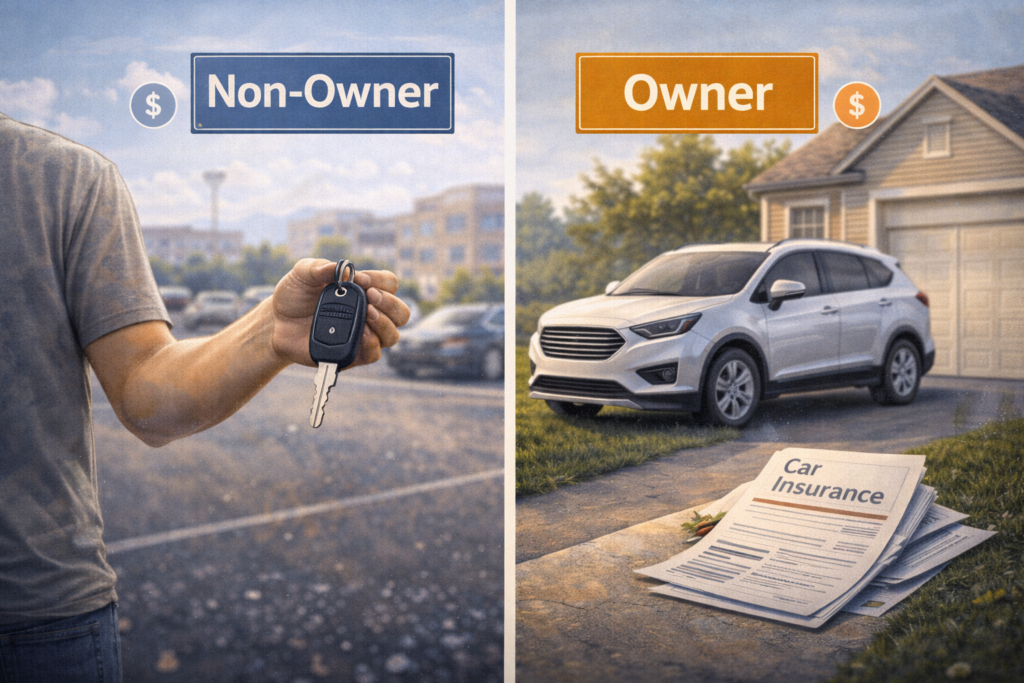
When I first started researching non-owner car insurance, I assumed it was just a “cheaper version” of regular auto insurance. I thought: no car, less risk, lower cost. Simple.
I was wrong.
What I discovered — after getting denied a rental, overpaying for the wrong policy, and almost causing a coverage gap — is that non-owner car insurance and standard auto insurance are built for completely different risk profiles.
If you’re in the same situation I was in — no car, but still driving occasionally — this breakdown might save you money and stress.
What Is the Real Difference?
Here’s the simplest explanation:
| Feature | Non-Owner Insurance | Regular Auto Insurance |
|---|---|---|
| Own a vehicle? | ❌ No | ✅ Yes |
| Covers a specific car? | ❌ No | ✅ Yes |
| Liability coverage | ✅ Yes | ✅ Yes |
| Collision coverage | ❌ No | ✅ Yes |
| Comprehensive coverage | ❌ No | ✅ Yes |
| Required by lender? | ❌ No | ✅ Yes |
| Average cost | $25–$60/month | $100–$250/month |
The biggest difference?
Non-owner insurance follows you.
Regular insurance follows your car.
That distinction changes everything.
Why I Almost Bought the Wrong Policy
When I sold my car two years ago, I assumed I could just cancel my insurance. After all, I didn’t own a vehicle anymore.
But then I realized:
-
I rent cars occasionally
-
I borrow friends’ cars sometimes
-
I didn’t want a coverage lapse on my insurance record
So I went online and started shopping.
Most quote tools asked for a VIN. I didn’t have one.
That’s when I discovered non-owner car insurance.
But here’s where it got tricky.
One company tried to sell me a standard policy without listing a vehicle. It was technically possible — but the price was nearly double what a proper non-owner policy would cost.
Lesson learned:
If you don’t own a car, make sure the policy type explicitly says “Non-Owner.”
What Non-Owner Insurance Actually Covers
Non-owner policies are primarily liability-based.
That means they cover:
-
Bodily injury to others
-
Property damage to others
-
Legal fees if you’re sued
They do NOT cover:
-
Damage to the car you’re driving
-
Theft of the car
-
Vandalism
-
Weather damage
When I first rented a car, I assumed my non-owner policy would protect the rental itself.
It doesn’t.
It protects you from liability claims — not the vehicle.
For rental car damage, you either need:
-
The rental company’s collision damage waiver
-
Or a credit card that includes rental coverage
When Regular Auto Insurance Makes More Sense
There are clear cases where non-owner insurance is the wrong choice:
1️⃣ You own or co-own a car
Even if it’s rarely driven, you need a standard policy.
2️⃣ You live with someone who owns a car
Many insurers require you to be listed on a household policy instead.
3️⃣ You drive the same vehicle frequently
If you regularly use your partner’s car, insurers may consider you a primary driver.
I once tried to use non-owner insurance while driving my roommate’s car several times per week.
The insurer flagged it and said that exceeded “occasional use.”
Non-owner insurance is built for:
-
Occasional rentals
-
Borrowing cars infrequently
-
Maintaining continuous coverage
The Cost Comparison (Real Numbers)
When I compared quotes, here’s what I saw:
| Scenario | Monthly Premium |
|---|---|
| Non-owner liability only | $38 |
| Basic regular policy | $128 |
| Full coverage regular policy | $182 |
That’s a $90–$140 monthly difference.
But remember:
The cheaper option only works if your situation qualifies.
Trying to force-fit non-owner insurance into the wrong scenario can lead to claim denial.
And that’s far more expensive.
Hidden Risk: Coverage Gaps
One of the biggest reasons I kept non-owner insurance was this:
Insurance companies punish coverage lapses.
Even a 30-day gap can raise future premiums significantly.
When I got a new car later, my continuous coverage record helped keep my rate reasonable.
Without non-owner insurance, I would’ve had a 14-month gap.
That could have cost me thousands over time.
Who Should Choose Non-Owner Insurance?
After living through both types, here’s who I believe truly benefits:
✔ Drivers who rent cars multiple times per year
✔ People between vehicles
✔ Drivers who use car-sharing services
✔ People rebuilding insurance history
✔ Drivers who sold a vehicle but plan to buy again
Who should NOT choose it:
❌ Full-time drivers
❌ Delivery / rideshare drivers
❌ People with access to one household vehicle daily
The Psychological Mistake Most People Make
Here’s something I didn’t expect:
People assume cheaper means weaker.
But non-owner insurance isn’t “weak” — it’s specialized.
It’s designed for a specific driving pattern.
Think of it like this:
Regular auto insurance = full-time vehicle ownership protection
Non-owner insurance = part-time liability shield
Different tool. Different job.
The One Question You Must Ask Before Buying
Instead of asking:
“How much does it cost?”
Ask:
“How often am I realistically driving someone else’s vehicle?”
Be brutally honest.
Insurance companies care about patterns, not intentions.
If you drive more than occasionally, they will classify you differently.
My Final Take
Non-owner car insurance saved me money and protected my insurance history.
But it only worked because I truly didn’t own a vehicle and drove infrequently.
If you’re in between cars or only drive occasionally, it can be a smart financial move.
If you drive regularly, it’s the wrong solution.
The biggest mistake is assuming they’re interchangeable.
They’re not.